
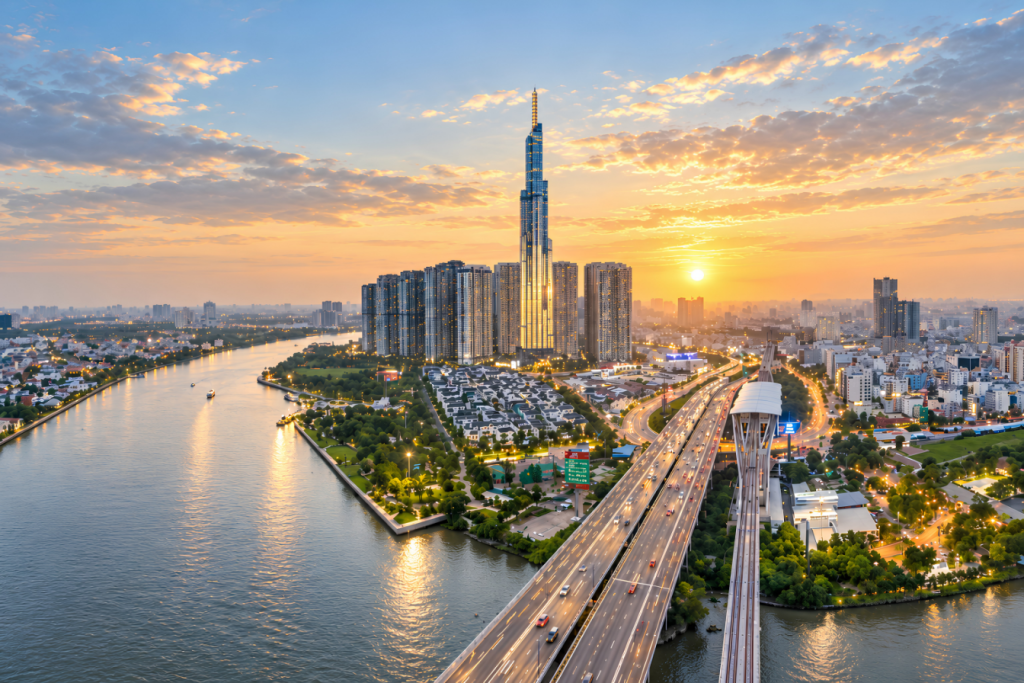
The Diplomat, a leading international current affairs magazine covering the Asia-Pacific region, has described Vietnam as the “undisputed champion” in attracting foreign direct investment (FDI) among the five Southeast Asian countries benefiting the most from the wave of FDI relocation.
Key Highlights of FDI Inflows into Vietnam in the First Six Months of 2026
In 2026, while many parts of the world continue to be affected by geopolitical conflicts, the Russia-Ukraine war, tensions in the Middle East and other uncertainties in the global economy, international corporations are increasingly seeking investment destinations that are safe, business-friendly and capable of delivering long-term efficiency. Against this backdrop, Vietnam has continued to maintain a stable macroeconomic foundation and remains a preferred destination in the ongoing restructuring of global supply chains.

According to data recently released by the General Statistics Office (Ministry of Finance), total registered foreign investment in Vietnam as of June 30, 2026, including newly registered capital, adjusted registered capital, and foreign investors’ capital contributions and share purchases, reached USD 34.65 billion, up 61% year-on-year. This represents a record increase in registered FDI capital for the economy in recent decades. Of this total, 2,013 newly licensed projects registered USD 17.39 billion in capital, up 1.3% year-on-year in the number of projects and 87.2% in registered capital.
Regarding investment partners, the General Statistics Office reported that among the 63 countries and territories with newly licensed investment projects in Vietnam during the first six months of 2026, Singapore was the largest investor, contributing USD 7.31 billion and accounting for 42.1% of total newly registered capital. It was followed by South Korea with USD 5.45 billion, accounting for 31.4%; Japan with USD 1.2 billion, accounting for 6.9%; and China with USD 977 million, accounting for 5.6%.
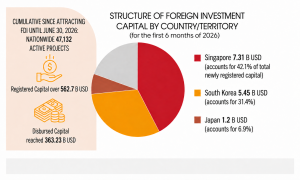
Source: Statistics Office. Graphics: Phương Anh
By investment sector, during the first six months of this year, the manufacturing and processing industry recorded the largest amount of newly licensed FDI, with registered capital reaching USD 10.76 billion, accounting for 61.9% of total newly registered capital. Electricity, gas, water production and distribution, and air conditioning accounted for USD 3.08 billion, or 17.7%; while the remaining sectors accounted for USD 3.55 billion, or 20.4%.
Vietnam: The Undisputed Champion!
In 2026, trade wars and geopolitical tensions are gradually bringing an end to an era of flourishing globalization. As a result, the global trade landscape has also been fundamentally reshaped. According to The Diplomat, 2024 marked the first time in history that foreign direct investment (FDI) flows into China turned negative. After maintaining a surplus for decades, net FDI into the country declined by nearly USD 170 billion. However, this enormous pool of capital has not disappeared; instead, it is increasingly flowing into Southeast Asia through the “China + 1” strategy. In its in-depth analysis of this relocation wave, The Diplomat concluded that among the five Southeast Asian countries benefiting the most, Vietnam is the “undisputed champion”.
According to The Diplomat, the increasingly intense strategic competition between the United States and China has disrupted the international trade order. This reality has placed multinational corporations, many of which previously invested heavily in China, in a difficult position. The future of many businesses now appears to be squeezed between U.S. tariffs, rivalry among major powers, and the risk of conflicts that could erupt in the future. This environment has prompted many companies to pursue the “China + 1” strategy, an approach aimed at diversifying supply chains by seeking alternative manufacturing hubs elsewhere in Asia. The objective is not to withdraw entirely from the Chinese market, but rather to adopt a risk-mitigation measure: creating an additional “plus one” option to diversify and reduce exposure. This inevitably means that investment flows into China will contract, making room for other countries. Among them, Southeast Asia, a dynamic growth region with a population of approximately 700 million, is emerging as one of the most attractive destinations. Over the past decade, global corporations have actively shifted manufacturing operations and supply chains to countries such as Vietnam, Malaysia, Indonesia and Thailand to reduce excessive dependence on China. As a result, capital inflows into the region surged to USD 236 billion in 2023, well above the annual average of USD 190 billion recorded during the 2020-2022 period.
Notably, in the increasingly fierce race to attract FDI, Vietnam previously had to work hard to keep pace with regional “giants” such as Thailand (an automotive industry hub), Malaysia (with strengths in semiconductor testing), Indonesia (with its superior market scale and resources). However, in this latest wave of restructuring, Vietnam has made a remarkable breakthrough to take the lead, becoming the “undisputed champion”.
The Diplomat assessed that Vietnam has surpassed its formidable competitors among Southeast Asia’s Top 5 by combining a distinctive set of advantages: a strategic location bordering China that helps optimize logistics costs, competitive labor costs, and an extensive network of free trade agreements (FTAs). As a result, Vietnam has not only attracted investment for basic assembly activities but has also officially moved ahead of regional competitors to become a central link and strategic bridge for both Western corporations and Chinese enterprises in maintaining and upgrading global supply chains.
As competition to attract FDI becomes increasingly intense, strategic investors are placing greater emphasis on institutional quality, policy predictability, workforce capabilities, and the speed at which the Government implements reforms. Productivity, automation and innovation are also becoming more important than hourly wage levels. Vietnam has addressed these priorities by continuing institutional reforms, enhancing policy transparency and predictability, and improving infrastructure quality and the economy’s absorptive capacity through Resolution No. 10-NQ/TW, dated June 8, 2026, issued by the Politburo on the development of the foreign-invested economic sector.
The results achieved in attracting FDI during the first six months of 2026 clearly demonstrate that Vietnam is not merely a reliable manufacturing and processing hub, but is transforming into a strategic destination for high-quality capital flows. Balanced growth across newly registered investment, capital increases and actual disbursement has become an important driver of economic growth.

Head of Market Intelligence, PeopleWise Vietnam.
As a Ph.D. , Research in Economics, Tuyen Le provides market insights, industry trends, and research on labor and workforce effectiveness. Through her research and analysis, she helps business leaders identify potential risks and threats to their businesses and industries, allowing them to take preemptive measures and invest with calculated risks and outcomes.