

Amidst a population exceeding 102 million and the ambition to enter an “era of national rise,” Vietnam is still grappling with an age-old paradox: a “surplus of degree holders, but a shortage of skilled workers”. In 2026, despite an abundant labor force, Vietnam still lacks technical personnel, while many workers struggle to find suitable employment. The gap between education and market demand is becoming a bottleneck for productivity and investment attraction.
Overview of Vietnam’s Labor Market in 2026
The labor market in the first half of 2026 recorded positive signals as production and business activities rebounded, driving a sharp increase in recruitment demand. According to a report by the General Statistics Office (GSO), the labor force aged 15 and over in Q1/2026 in Vietnam was estimated at 53.6 million, a decrease of 232.9 thousand compared to the previous quarter but an increase of 687.8 thousand year-over-year. The labor force participation rate in Q1/2026 stood at 68.3%, down 0.4 percentage points from the previous quarter but up 0.1 percentage points year-over-year. The proportion of trained workers with degrees or certificates in Q1/2026 was 29.6%, up 0.1 percentage points quarter-over-quarter and 0.8 percentage points year-over-year.
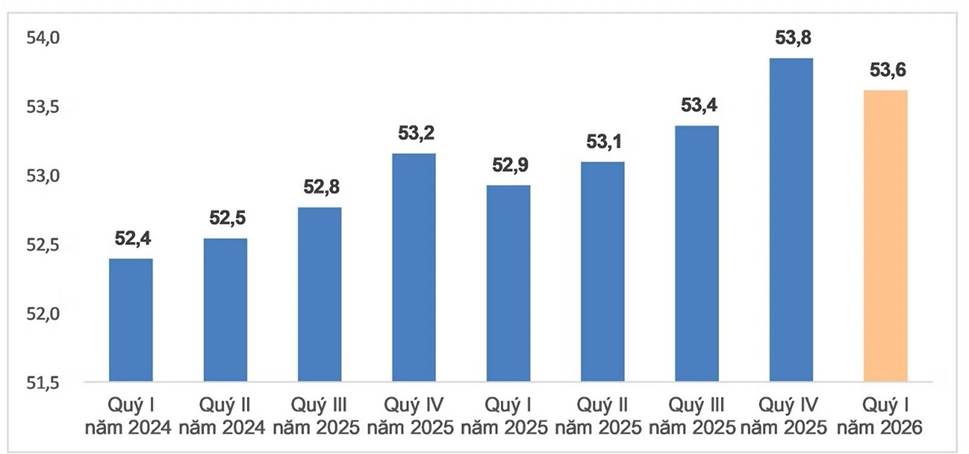
This recovery was driven by the efforts of competent authorities and employment service centers nationwide to enhance labor supply-demand matching, primarily through frequent and diverse job fairs and virtual connections between provinces. However, according to the Ministry of Home Affairs, localized unemployment persists, and the “surplus of degree holders, shortage of skilled workers” paradox remains prevalent. Labor demand in sectors such as information technology, semiconductors, and artificial intelligence (AI) has surged, yet Vietnam has not been able to meet it. The root cause, according to the Ministry of Home Affairs, is the low quality of human resources. Currently, only about 29.2% of the Vietnamese workforce holds vocational certificates, failing to adequately meet market requirements amidst global integration and digital transformation.
Labor Supply and Demand Mismatch
In Ho Chi Minh City, the labor market entered Q2/2026 with promising signs as enterprises simultaneously ramped up recruitment to fulfill new orders and expand production. Data from the HCMC Center of Employment Services (CES) indicates that the city will generate roughly 60,000-75,000 job opportunities, concentrated in manufacturing, engineering, technology, and logistics. This is considered a “golden period” for job seekers, especially those looking to switch jobs or advance their careers. However, beneath this vibrant picture lies a notable reality: labor supply and demand are failing to meet; in fact, the mismatch is widening. For the manufacturing and machine operation sector, recruitment demand currently stands at 15.41% (12,756 positions), while the corresponding supply is only 7.46% (3,925 people). This disparity indicates that this will remain a sector with high manpower demand in the foreseeable future. Additionally, several “hot” professions are expected to see increased recruitment demand in Q2/2026, including E-commerce, Digital Marketing, Information Technology, Cybersecurity, Automation Engineering, Industrial Maintenance, Supply Chain Management, Hotel Management, Port Coordination, Marine Engineering, and Import-Export. Conversely, the Marketing & Communications sector has a labor supply of 9.58%, whereas recruitment demand through the system is merely 1.27%. This demonstrates a highly abundant supply in this sector relative to the demand via public employment service channels.
On another note, university-educated workers account for over 13% of the labor supply, but the recruitment demand for this demographic is only about 4.4%, leading to fierce competition. Many graduates are forced to accept underemployment or pivot their career paths to maintain an income. In contrast, unskilled labor, particularly in manufacturing and services, is experiencing a shortage. Recruitment demand for this group makes up nearly 70%, while the supply meets only about half. This “mismatch” reflects a structural issue: the education system is failing to keep pace with the practical needs of enterprises, while workers lack the appropriate skills to immediately enter the market.
In Hanoi, a survey by the Hanoi Center for Employment Services reveals that the demand for technical and skilled personnel has increased, but the supply falls short. Specifically, data from April 2026 shows an estimated recruitment demand of 55,000 positions, whereas only about 35,000 job seekers were recorded. Beyond the numerical shortage, the labor structure is also imbalanced: those with a university degree or higher make up 35.8%, and untrained workers account for 37.8%, leaving a rather limited pool of workers with intermediate and college-level vocational degrees. This results in a severe shortage of mid-level technical workers, the very demographic that plays a direct role in production.

Underlying Causes
Although increased recruitment is a positive sign, many businesses still face hiring difficulties, particularly for highly skilled positions. On the surface, this is a paradox: places needing labor cannot hire, while workers remain unemployed. However, a comprehensive view reveals that this is a manifestation of the labor supply-demand mismatch, stemming from multiple intertwined causes.
First, according to many labor experts, the core issue is not that Vietnam has too many university graduates, but rather the imbalance between the educational structure and the actual needs of the labor market. For years, an “obsession with degrees” has led many families to view a university education as the mandatory path to success. This mindset pushes a massive influx of students into “trendy” majors like economics, marketing, communications, management, or finance, with little consideration for graduation outcomes. Meanwhile, fields such as engineering, mechanics, industrial electricity, manufacturing, or vocational training systems severely lack appeal despite being starved for personnel. Consequently, the market has fallen into a structural mismatch: a surplus of white-collar office workers alongside a critical shortage of skilled technical personnel.
Second, the current reality is that many repetitive office jobs are gradually being replaced or significantly downsized. AI tools can process data, draft documents, compile reports, or translate much faster than humans, sharply reducing operating costs for businesses. Therefore, in many companies, roles such as data entry, basic administrative assistants, simple content editing, or operational marketing tasks have been partially automated by AI. This puts workers who possess only theoretical knowledge, lack practical application skills, and are unable to utilize technological tools at risk of being replaced or facing tougher competition in the labor market. Conversely, jobs requiring system operation capabilities, practical troubleshooting, in-depth technical skills, or quick reaction thinking maintain high stability. Examples include mechatronics technicians in factories, supply chain logistics operators, or automation system maintenance technicians. These are positions that AI can hardly replace completely because they require a combination of technical expertise, practical experience and on-the-spot problem-solving abilities, yet companies struggle to fill them.

Another crucial factor is the shifting career preference among young workers. Instead of working in factories, on assembly lines, or in shifts, a segment of the youth, especially Gen Z workers, prioritizes flexible jobs where they can manage their own time, such as ride-hailing drivers, online sellers or freelancers. Today’s youth value experiences, autonomy and work environments that align with modern lifestyle values. As a result, some young workers are unenthusiastic about traditional blue-collar jobs, especially when they cannot see a clear roadmap for income and skill advancement.
Furthermore, recruiting unskilled labor is challenging because many workers choose to work closer to home to save on living costs, even if the wages are lower. For instance, in the past, workers from rural provinces typically flocked to HCMC and Binh Duong to seek employment in industrial zones. However, many provinces have now developed their own industrial zones, creating local jobs and making workers less inclined to migrate. This creates a stark supply-demand divergence: businesses need highly skilled labor, whereas the supply predominantly consists of untrained workers who desire light workloads, high salaries, and minimal overtime, completely contradicting manufacturing requirements that necessitate overtime to meet production schedules.
In the long term, the narrative of the labor market is no longer about surplus or shortage, but about quality. As the economy transitions toward a model based on technology and high value-added industries, competitive advantage no longer lies in the sheer volume of labor, but in actual working capabilities. In this context, the proposed solutions are to elevate training quality, forge closer ties between educational institutions and enterprises, and promote the reskilling of the existing workforce. Additionally, relevant authorities must step up support for retraining, job matching, and career transitioning for workers affected by automation. Despite the rapid advancement of AI, employment opportunities remain vast in many sectors that require hands-on labor, human creativity, and critical thinking, provided that workers are willing to adapt and upskill.

Head of Market Intelligence, PeopleWise Vietnam.
As a Ph.D. , Research in Economics, Tuyen Le provides market insights, industry trends, and research on labor and workforce effectiveness. Through her research and analysis, she helps business leaders identify potential risks and threats to their businesses and industries, allowing them to take preemptive measures and invest with calculated risks and outcomes.
Interesting read on Vietnam’s skilled-labor gap. It’s clear this isn’t just a policy issue but a real operational bottleneck for shops and clinics aiming to scale. In Suplery we’ve seen how streamlined team and inventory workflows can cut downtime and misfires in hiring pipelines. My statement can be biased, but a single dashboard for suppliers and real-time stock checks help you keep production running even when skilled labor is scarce. For barbershops, saloons, and skincare clinics, this translates to faster onboarding, better product data, and predictable delivery. If you’re upgrading ops, Suplery offers a professional platform with wholesale pricing and automated order prediction to scale efficiently.
This article hits on a crucial reality: the rise of AI is not just replacing roles but redefining the skills required for the modern workplace. It is a wake-up call that theoretical knowledge alone is no longer sufficient; practical application and the ability to leverage technology are the new prerequisites for career stability. A very timely and thought-provoking read.