
Amid increasingly complex global geopolitical dynamics and the implementation of the global minimum tax, Vietnam continues to affirm its position as a stable, safe, and highly attractive destination for foreign direct investment (FDI). A strong macroeconomic foundation combined with positive growth prospects has reinforced the confidence of the international investment community.
Overview
Entering early 2026, the global economy continues to face multiple uncertainties. Inflation in several major economies remains elevated, leaving limited room for a rapid decline in global interest rates. Meanwhile, geopolitical tensions in the Middle East and other regions continue to exert pressure on energy prices and global logistics costs. In addition, fluctuating trade and tariff policies among major economies have created an increasingly unpredictable environment for international investment and trade.
Against this backdrop of global economic uncertainty, many multinational corporations are adjusting their investment strategies with greater caution, prioritizing the optimization of existing supply chains and reassessing plans for overseas expansion. Nevertheless, the restructuring of supply chains across the Asia Pacific region continues to accelerate. In this shift, Vietnam is widely regarded as an attractive destination due to its stable political environment, extensive network of free trade agreements, and strategic position within regional manufacturing and supply chains.
Key Factors Strengthening Vietnam’s FDI Attractiveness
The year 2026 is considered the starting point of a new development cycle for Vietnam’s economy, as the recovery momentum built during 2024–2025 has created a stronger and more resilient foundation than in previous periods. In the context of global economic uncertainty, international organizations are no longer focusing solely on Vietnam’s growth figures but are increasingly emphasizing the quality, structure, and adaptability of the country’s economy.
In its latest report, international law firm D’Andrea & Partners Legal Counsel (DP Group) ranked Vietnam among the seven most promising markets in Asia for attracting FDI. The report describes Vietnam’s FDI outlook for 2026 as “cautiously optimistic.” According to the analysis, one of the key factors reinforcing Vietnam’s attractiveness to foreign investors is its solid macroeconomic foundation, along with improvements in workforce quality and infrastructure development.
Meanwhile, Mariam J. Sherman, World Bank Director for Vietnam, Cambodia, and Laos, highlighted that Vietnam’s advantages lie in its strategic position along major Asian trade routes, an increasingly robust industrial base, an extensive network of free trade agreements, and a competitive workforce. These factors continue to place Vietnam among the most dynamic economies in ASEAN in the 2026 economic outlook reports.
Other international financial institutions also maintain a positive view of Vietnam’s growth trajectory. According to forecasts from UOB, Citi, and Standard Chartered, Vietnam’s gross domestic product (GDP) growth in 2026 could reach 7.2% – 8%, supported by the strong growth base of 2025 and the continued expansion of foreign direct investment, particularly in high technology, semiconductors, and renewable energy sectors.
These positive signals demonstrate that foreign investors continue to place strong confidence in Vietnam’s stable business environment and effective macroeconomic policies. In 2025, the manufacturing and processing sector remained the primary driver of FDI inflows, with disbursed capital reaching USD 22.88 billion, accounting for 82.8% of total realized FDI. This trend indicates that foreign capital is increasingly directed toward industries that generate substantial value-added and broader economic spillover effects.
Additionally, capital contributions and share acquisitions experienced remarkable growth, with 3,587 transactions recorded and a total value of USD 7.03 billion, representing a 54.8% increase compared to 2024. This reflects a growing tendency among foreign investors to enter the Vietnamese market more rapidly by leveraging the existing infrastructure, production capacity, and market share of domestic enterprises.
Notably, Vietnam achieved an impressive GDP growth rate of 8.02% in 2025, significantly exceeding the government’s initial target as well as the forecasts of many international organizations. This performance highlights the country’s substantial economic potential, as well as the flexibility, effectiveness, and decisive policy direction of the Vietnamese government.
Another noteworthy improvement is the enhancement of workforce quality. The expansion of vocational training programs, along with collaboration between educational institutions and multinational corporations, is gradually helping Vietnam transition from a labor-intensive manufacturing model to higher value-added production. This shift is particularly critical for high-tech industries, where the demand for skilled and stable human resources is increasingly important.
Vietnam Remains a Preferred Destination for FDI Investors
In 2026, Vietnam’s FDI attraction is not only maintaining strong capital inflows but is also showing a shift toward higher-quality investment, further reinforcing foreign investors’ confidence in the country’s business environment and macroeconomic policies.
According to a report by the Foreign Investment Agency under the Ministry of Finance, the total registered foreign direct investment (FDI) in Vietnam since the beginning of the year has reached USD 6.03 billion. Meanwhile, disbursed FDI capital totaled USD 3.21 billion, marking an 8.8% increase compared to the same period last year and the highest level recorded for the same period in the past five years.
Total registered foreign investment in Vietnam includes newly registered capital, adjusted capital, and capital contributions or share purchases by foreign investors. Among these, newly registered investment accounted for 620 licensed projects, with a total value of USD 3.54 billion, representing a 20.2% increase in the number of projects and a 61.5% rise in registered capital year-on-year.
Regarding adjusted capital, 180 previously licensed projects registered additional investment capital of USD 1.99 billion. In addition, foreign investors recorded 492 capital contributions and share acquisition transactions, with a total value of USD 499.5 million. Specifically, 128 transactions involved capital contributions or share purchases that increased the charter capital of enterprises, totaling USD 297.8 million. Meanwhile, 364 foreign investors acquired shares in domestic companies without increasing charter capital, with a combined value of USD 201.7 million.
Among the 44 countries and territories with newly licensed investment projects in Vietnam during the first two months of 2026, South Korea ranked as the largest investor, contributing USD 1.34 billion, equivalent to 37.8% of total newly registered capital. This was followed by Singapore with USD 1.1 billion (31.1%), China with USD 522.8 million (14.8%), Japan with USD 171 million (4.8%), the Hong Kong Special Administrative Region (China) with USD 143 million (4.0%), and the United States with USD 85.6 million (2.4%).
The sectors receiving the most attention from FDI investors include manufacturing and processing, which attracted USD 2.65 billion, accounting for 82.7% of total realized FDI. This was followed by real estate business activities with USD 223.5 million (7.0%), and electricity, gas, steam, and air-conditioning supply with USD 119.2 million (3.7%).
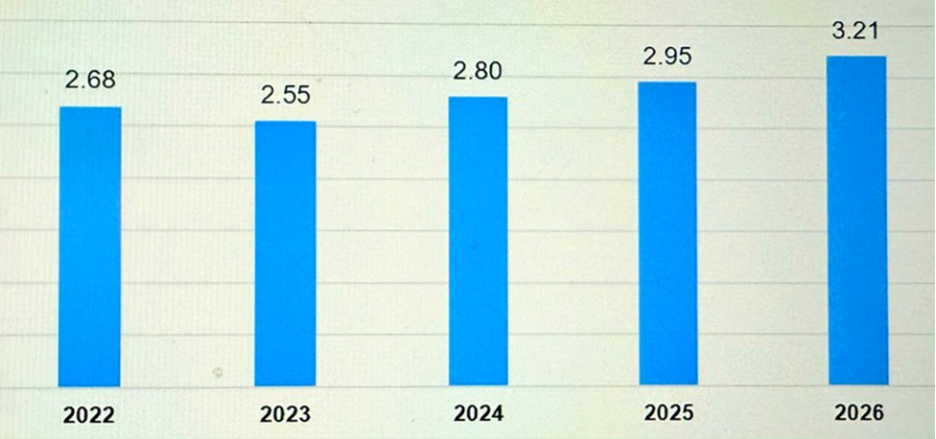
Realized Foreign Direct Investment in the First Two Months, 2022–2026 (USD billion)
Market sentiment is gradually improving, although global trade tensions continue to place considerable pressure on business activities. Nevertheless, with a score of 80 the highest level in the past seven years, the Business Confidence Index (BCI) for Q4 2025, released by the European Chamber of Commerce in Vietnam (EuroCham), reaffirms the confidence of European businesses in Vietnam. This recovery further strengthens Vietnam’s position as a strategic investment destination and a leading growth engine in the region.
Notably, Bruno Jaspaert, Chairman of EuroCham, commented:
“The latest BCI confirms what we have already observed in practice. After many years fluctuating around the neutral threshold, reaching a score of 80 shows that today’s confidence is no longer based solely on expectations, but is supported by real developments: factories are operating steadily, orders are gradually recovering, and investment decisions are being implemented. Vietnam is entering a period of structural transformation, steadily asserting its role as a key growth driver on its path toward becoming one of the top three economies in ASEAN.”
Vietnam’s attractiveness continues to be reinforced by strong support from the business community. Up to 87% of surveyed companies stated they would recommend Vietnam as an investment destination to other foreign businesses, with the highest level of confidence coming from large-scale enterprises.
Overall, after several years affected by global disruptions and uncertainties, the BCI for Q4 2025 indicates that investor sentiment among FDI enterprises in Vietnam has returned to a growth zone, surpassing levels recorded prior to the announcement of U.S. tariffs and even before the COVID-19 pandemic. Confidence is increasingly becoming a key driver behind expansion and investment decisions in the coming period.

Head of Market Intelligence, PeopleWise Vietnam.
As a Ph.D. , Research in Economics, Tuyen Le provides market insights, industry trends, and research on labor and workforce effectiveness. Through her research and analysis, she helps business leaders identify potential risks and threats to their businesses and industries, allowing them to take preemptive measures and invest with calculated risks and outcomes.